
Physical AI: How investors can invest in robotics
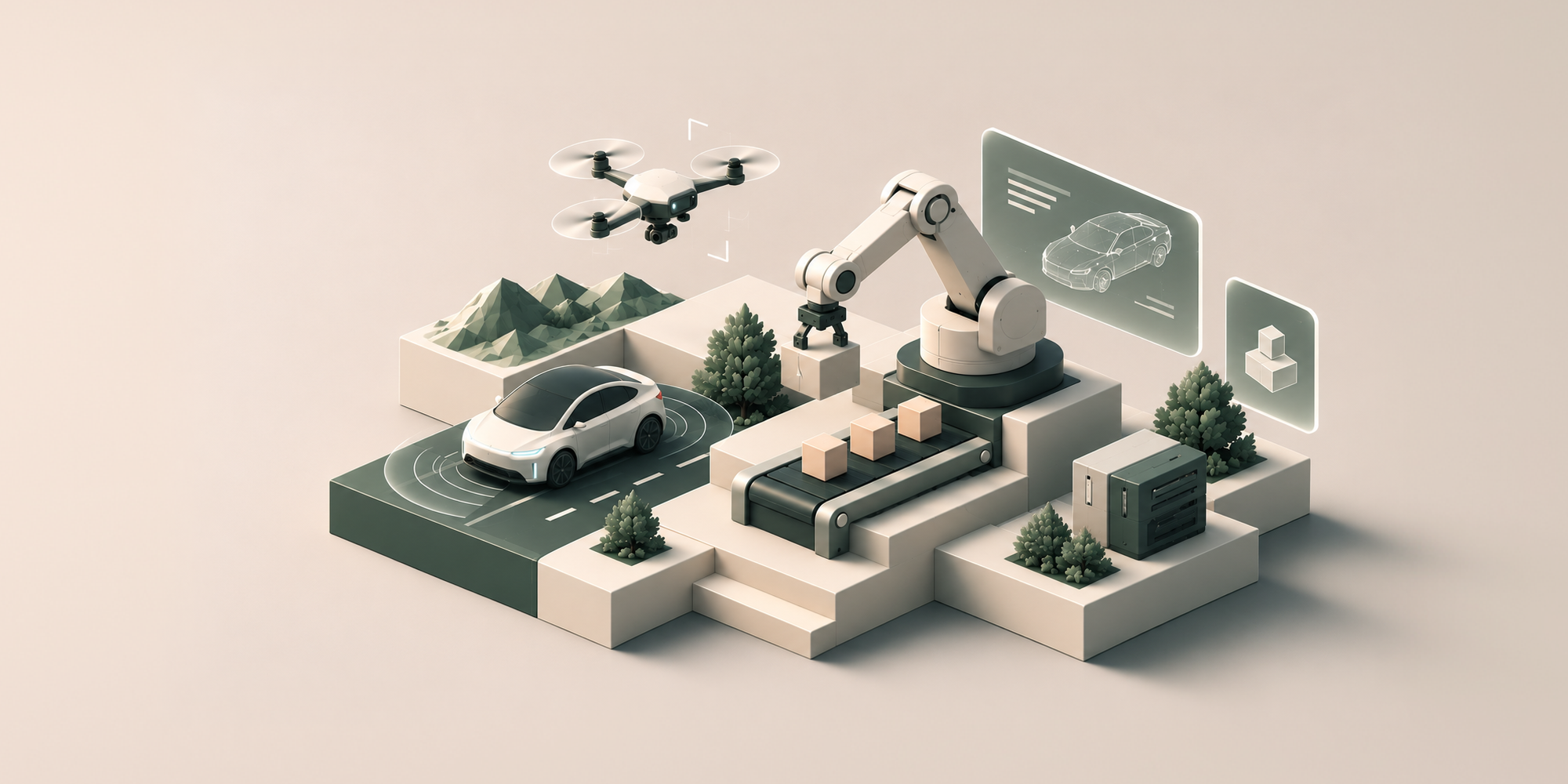
You have read that robotaxis are driving through the streets of London and robots are carrying boxes in factories, and you are wondering how you can take part in this development? Both are driven by physical AI: artificial intelligence that perceives its surroundings and controls machines in the real world. According to Crunchbase, robotics start-ups had raised more money by the end of June 2026 than in the whole of the record year 2025. Most of the companies developing this technology are private. If you want a stake in them, a fund is usually the only way in. Our article public vs. private markets explains what separates private and listed companies for investors.
Physical AI at a glance
- Physical AI refers to AI that controls machines such as robots or vehicles and uses sensors to perceive its surroundings.
- According to Crunchbase, robotics start-ups raised around 18.8 billion US dollars by 22 June 2026, more than in the whole of 2025.
- Wayve (autonomous driving) and Shield AI (AI pilot for drones) are private companies and are held in the ARK Private Innovation ELTIF.
- Through target funds, the Redstone Global Venture ELTIF holds stakes in European robotics start-ups such as Allsides and Flyability.
- The companies need a lot of capital and years to reach market maturity. In a fund, your money is tied up for a long time, and losses up to and including total loss are possible.
What is physical AI and why is so much capital flowing into it in 2026?
Language models such as ChatGPT work with text and images on a screen. Physical AI goes one step further: the software controls machines that move through space. Take a self-driving car: it detects a pedestrian and decides whether to brake. A drone finds its way through a hall without GPS, and a robotic arm grips parts it has never seen before. NVIDIA CEO Jensen Huang popularised the term in January 2025 at the CES technology fair. He described physical AI as AI that understands its surroundings and acts within them.
For a long time, robots failed in situations nobody had programmed them for. New AI models learn movements from simulations and real sensor data and transfer what they have learned to new tasks. At the same time, sensors have become cheaper and chips powerful enough to compute directly inside the robot.
Investors are backing this on a large scale. According to Crunchbase, around 15 billion US dollars went into robotics start-ups in 2025, a record. By 22 June 2026, the figure had already reached 18.8 billion US dollars. Among the largest rounds of the year are those of Skild AI, which is building a shared AI model for many types of robot, and Neura Robotics from Metzingen. Episode #72 of our podcast Diversify (in German) looks at who finances such future technologies in Germany. How you can invest in AI companies that develop language models is covered in our article Investing in AI.
Physical AI at its core: Wayve and Shield AI
Two companies show well what physical AI can already do today. Both are private and, as of 3 November 2026, held in the ARK Private Innovation ELTIF. Our article pre-IPO investing explains how investors can access such companies before an IPO.
Wayve: autonomous driving with a learning AI model
Wayve was founded in London in 2017 and is led by co-founder Alex Kendall. The company teaches cars to drive with a single AI model that learns from driving data. Conventional systems, by comparison, rely on many individually programmed rules and high-precision maps. This approach is therefore meant to transfer more quickly to new cities and vehicles.
In February 2026, Wayve raised 1.2 billion US dollars at a valuation of 8.6 billion US dollars. For the first time, its backers include carmakers such as Mercedes-Benz and Nissan. Nissan plans to build the software into its ProPILOT assistance system in Japan from the 2027 financial year. Together with Uber, Wayve has been testing robotaxis in London since September 2026, for now with safety drivers on board.
Shield AI: an AI pilot for drones and aircraft
Shield AI from San Diego develops Hivemind, software that flies drones and aircraft autonomously, even when GPS and radio are jammed. The company builds its own aircraft such as the V-BAT drone and licenses Hivemind to other manufacturers. In March 2026, a funding round valued Shield AI at 12.7 billion US dollars. According to media reports, it is now negotiating a new round at 20 billion US dollars or more.
Most of its customers are armed forces, above all the US military. For investors, this means the business depends on defence budgets, and whether defence technology fits your own portfolio is a decision each investor makes for themselves. You can read more about valuation and a possible IPO in our article on Shield AI stock.
The suppliers: training data and digital twins
Today, a robot learns to grip and walk largely in simulation. There it can make millions of attempts without anything breaking. For this to work, the simulation needs precise digital copies of real objects, known as digital twins.
This is where Allsides comes in. The company from South Tyrol, previously known as Covision Media, scans real objects in 3D and turns them into models that can be used directly in robot training environments such as NVIDIA Isaac Sim. NVIDIA works with Allsides as a partner, and the company now also has offices in New York and San Francisco.
This layer is interesting for investors because it supplies many robot makers and depends less on who ultimately prevails. The Redstone Global Venture ELTIF holds a stake in Allsides through the target fund Euregio+ Alpine Venture Capital.
Robotics in practice: Elvio Robotics, Flyability and Tethys Robotics
Many robotics start-ups solve a very specific problem. They send machines to places that are dangerous or hard to reach for people, or take on work for which staff are lacking. The following companies belong to the portfolio of the Redstone Global Venture ELTIF, which holds them through target funds.
Flyability: drones for indoor inspections
Flyability, based near Lausanne, builds drones that fly inside a protective cage and withstand collisions with walls. They inspect boilers, tanks, mines and sewers that people would otherwise have to descend into on ropes. The Elios 3 drone uses a laser scanner to create 3D maps in real time. According to the company, Flyability has almost 1,000 customers. Redstone holds its stake through Future Industry Ventures, a fund for industrial technology that Redstone launched together with SBI.
Tethys Robotics: underwater inspections
Tethys Robotics is a spin-off of ETH Zurich. Its underwater drone Tethys ONE dives to depths of up to 300 metres and inspects, for example, the foundations of offshore wind farms. Until now, such work has been done by commercial divers, whose job is considered particularly dangerous. At the end of 2025, Redstone led Tethys's first funding round of 3.5 million euros.
Elvio Robotics: robots in hospitals
Elvio Robotics from Munich was founded in February 2026. Its software Elvio OS connects robots from different manufacturers with a hospital's technical systems, from the lifts to the IT. This allows transport and cleaning robots to move through the building on their own. The system is already in use at the Isar Klinikum in Munich. In October 2026, Elvio closed a funding round in the millions, in which the Redstone target fund HIC Fund II took part.
Unchained Robotics, which offers software for automation with industrial robots, is also in the portfolio.
Investing in physical AI through NAO
In the NAO app, you will find two funds that hold stakes in companies from this field. They cover different parts of it: the ARK fund holds Wayve and Shield AI, two well-known physical AI companies in late growth stages, while the Redstone fund holds young European robotics start-ups. In both funds, physical AI is one focus among several, and the app does not offer a pure robotics fund. Our investment team reviewed both, as it does every fund in the app. We take on 1 in 8 funds.
ARK Private Innovation ELTIF
ARK Invest launched the ARK Private Innovation ELTIF in January 2026. It invests in private technology companies in later growth stages, including Wayve and Shield AI as well as OpenAI and SpaceX. Wayve is testing its driving model together with Uber in London, and Shield AI sells the V-BAT drone with the Hivemind AI pilot to armed forces. You can invest with a one-off investment or a savings plan. A lock-up period applies until 26 February 2027, during which you cannot redeem your units. You can find the fund on our private equity page.
Redstone Global Venture ELTIF
Redstone is a venture capital firm from Berlin that has been investing in young technology companies since 2014. The Redstone Global Venture ELTIF was launched on 1 April 2025 and invests in the firm's own venture capital funds. Through these target funds, it holds stakes in young companies including Allsides, Flyability, Tethys Robotics and Elvio Robotics, as well as companies from other sectors such as fintech and healthcare. It thereby covers the part of physical AI where robotics is already in use today: training data for robots, drone inspections above and below water, and robots in hospitals. The minimum holding period is seven years. After that, you can redeem your units with a notice period to the end of a quarter. More about the fund is on our venture capital page, and our guide to investing in venture capital explains the basics.
With a fund unit, you hold a stake in a portfolio whose composition can change at any time. Our overview of the ELTIF explains how an ELTIF is structured and when redemptions are possible.
Risks of investing in physical AI
If you hold a stake in robotics companies through a fund, you mainly bear these risks:
- Capital requirements: Robots and vehicles need expensive hardware and long testing. Many companies have to raise new money again and again over the years, which can dilute early stakes.
- Development time: It often takes years to get from prototype to series product. Shield AI does not plan to start series production of its uncrewed fighter jet X-BAT until 2029.
- Regulation: Autonomous driving requires approvals. In the United Kingdom, the law on self-driving cars is not expected to apply in full until the second half of 2027.
- Defence exposure: Shield AI sells mainly to armed forces, so the business depends on budgets and export rules.
- Valuation: Valuations from funding rounds can fluctuate sharply. At Shield AI, the valuation more than doubled between March 2025 and March 2026. There is no market price, and the fund values its holdings on the basis of funding rounds and models.
- Early stage: Many holdings in the Redstone fund are young companies, some of which may fail.
What does this mean for you?
Physical AI is still at an early stage. Many of the companies driving the technology are private and need years before it becomes clear whether their business works. Through a fund, you can take a stake and spread the risk across many companies. Before you decide, you can ask yourself:
- What share of your wealth should go into young technology companies?
- Does a stake in defence technology fit your investment principles?
- What does the fund cost, and when can you get your money back? The answers are in the key information document.
Do you have questions about the funds? Our customer service team is there for you in person on working days. Feel free to write to us.
FAQ
What is physical AI?
Physical AI is artificial intelligence that controls machines in the real world, such as robots or self-driving cars. It perceives its surroundings through sensors and decides on its own how the machine moves.
Which physical AI companies can you invest in through NAO?
Indirectly, through funds. The ARK Private Innovation ELTIF holds Wayve and Shield AI, among others, and the Redstone Global Venture ELTIF holds stakes in Allsides, Flyability, Tethys Robotics and Elvio Robotics through target funds (as of 3 November 2026). You cannot buy individual shares in these companies.
Is there a Wayve stock?
No. As of November 2026, Wayve is private and not listed on a stock exchange. Its most recent valuation was 8.6 billion US dollars in February 2026.
How risky is investing in physical AI?
Very risky. The companies need a lot of capital and often years to reach market maturity. In a fund, your money is tied up for a long time, and losses up to and including total loss are possible.
This article is for information purposes only and does not constitute investment advice. Investments in private markets are long-term, capital is tied up for the term, and losses up to and including total loss are possible. You can find the fund documents and the key information document in the NAO app.
Ready to join the NAO community?
Start today with access to exclusive private markets. Start investing like a millionaire, starting at just €1.